/appstore.png)
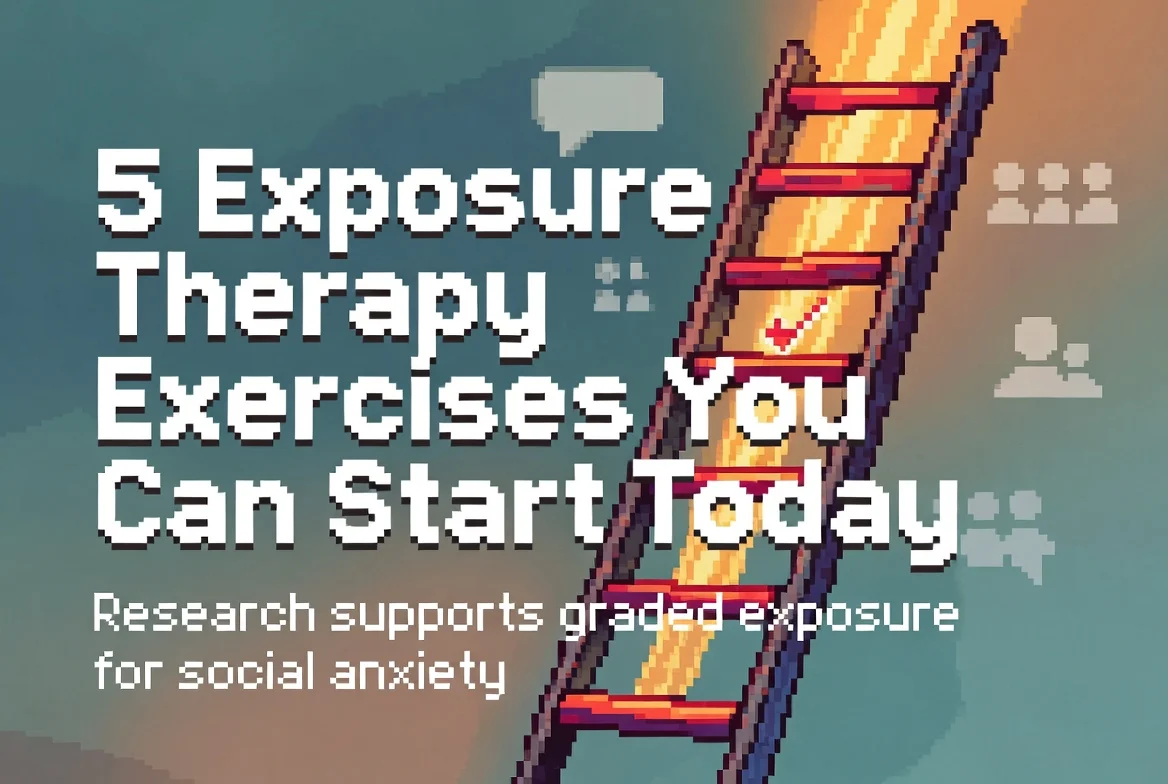
5 Exposure Therapy Exercises You Can Start Today
Research supports graded exposure for social anxiety. Build a ladder and try five low-stakes exercises you can start this week.
If you avoid social situations, your brain rarely gets a chance to update its predictions. The situations stay “dangerous” on paper forever—because you never collect real-world data in a controlled way.
Exposure therapy is about changing that deliberately: approaching what you fear in small, repeatable steps so anxiety can come down through experience, not argument. Large reviews and meta-analyses consistently find that cognitive-behavioural approaches—including formats built around exposure—are among the most evidence-supported psychological treatments for social anxiety disorder. 1 Meta-analyses of follow-up data also suggest that CBT for social anxiety often produces lasting benefits a year or more after treatment ends. 2
You don’t need to jump into your biggest fear on day one. The key is to start small, stay consistent, and move up the ladder at your own pace. Even brief, structured exposure practice delivered digitally has been shown to reduce social anxiety and increase self-efficacy compared with monitoring-only control conditions in a randomised trial—underscoring that repetition matters, not perfection. 3
Cherry is a practice tool, not a replacement for therapy. If social anxiety is significantly affecting your daily life, a mental health professional is the right starting point.
TL;DR
- Exposure means approaching what you avoid in small, planned doses—not white-knuckling your biggest fear immediately.
- Research supports graded exposure as part of evidence-based care for social anxiety.
- Pick one ladder, one step this week, and repeat until it gets boring before you level up.
Quick answers
Is exposure the same as “forcing yourself”?
No. Good exposure is predictable, chosen, and slightly uncomfortable—not unsafe, coerced, or humiliating.
What if I panic mid-exercise?
Have an exit plan, use grounding, and next time shrink the step. The goal is staying long enough to learn, not suffering.
How many reps?
More than once. Frequency matters more than a single heroic attempt.
| Principle | What it means |
|---|---|
| Graded | Start below your max fear |
| Repeated | Same step multiple times |
| Predictable | You choose when and how long |
Why exposure works (in plain language)
When we avoid social situations, we never test whether our fears are accurate. The brain keeps treating every invitation as a threat, so the anxiety stays high. Exposure works by giving you repeated, manageable practice: you stay in the situation long enough to learn you can cope, and that outcomes are often less catastrophic than you predicted.
That matches how clinicians summarise the literature: CBT packages for social anxiety—which typically include exposure-like behavioural practice—show reliable benefits across trials and formats. 1 5
I used to leave parties early or skip them entirely because I was sure I’d say something awkward or that people were judging me. Once I started doing small exposures—like staying five minutes longer or asking one person a question—I realised that most of the time nobody was scrutinising me, and even when I did feel anxious, I could still get through it. That’s the same principle behind the exercises below.
Building your exposure ladder
Before diving into specific exercises, it helps to have a simple ladder in mind. List situations that make you anxious, from least to most intense. Your first exposures should be on the lower rungs: mildly uncomfortable but manageable. As those get easier, you move up. This graded approach is what CBT and exposure protocols recommend—you build confidence step by step instead of overwhelming yourself.
Your ladder is personal. “Easy” for you might be saying hi once; for someone else it might be asking a stranger for directions. The research doesn’t require a specific task—it requires repeated contact with the type of situations you avoid, with difficulty scaled over time. 1 3
Five exercises you can start today
1. Make eye contact and say hello
Pick a low-stakes setting: a neighbour, a barista, or a colleague in the hallway. Your goal is simply to make brief eye contact and say hello (or “good morning”). You don’t need to start a conversation. You’re just practising being visible and offering a small, friendly gesture.
If that feels too big, scale it down: first just make eye contact with one person. Next time add a nod or a smile. Then add “hi.” Each step is a valid exposure. The point is to stay in the situation instead of avoiding it, even for a few seconds.
2. Ask one question in a group or meeting
In a meeting, class, or casual group, set a goal to ask one question or make one short comment. It doesn’t have to be profound. You might ask for clarification, agree with someone, or share a brief thought. Prepare it in your head if that helps, but the real exposure is saying it out loud and tolerating the attention.
Many people with social anxiety assume their question will sound stupid or that others will judge them. In reality, asking a question usually makes you seem engaged and interested. This exercise helps you test that belief in a concrete way.
3. Stay in a social situation a bit longer
Choose a situation you often leave early: a coffee break, a lunch, or a small gathering. Decide in advance to stay a set amount of time longer than you usually would—for example, five or ten minutes. You don’t have to talk more or do anything different; you’re just practising staying present while anxiety is there.
The aim is to learn that you can tolerate the discomfort and that it often goes down over time. You might notice that after a few minutes, your anxiety starts to ease. That’s your brain starting to update its predictions.
4. Give a small compliment or thank someone
Pick someone you interact with regularly—a colleague, a friend, or a family member—and give them a genuine compliment or thank them for something specific. For example: “I really liked how you explained that in the meeting,” or “Thanks for sending that through, it helped a lot.”
This exercise combines two things: initiating a positive social exchange and being the focus of a brief moment of attention. It’s a gentle way to practise that positive social interactions are possible and that people usually respond well to kindness.
5. Do something visible in public
“Visible” here means something that might make you feel noticed, even if others don’t care. Examples: asking a stranger for the time or directions, returning an item in a shop, or ordering something different from your usual at a café. The exposure isn’t the task itself; it’s doing it while accepting that you might feel anxious and that that’s okay.
Start with the version that feels only slightly uncomfortable. If asking a stranger for directions is too much, start with asking a friend or a staff member you see often. You can always add harder steps later.
What to expect as you practise
At first, many people notice that their anxiety spikes when they think about or start an exposure. That’s normal. The goal isn’t to eliminate anxiety before you act—it’s to act despite it. With repetition, the same situation tends to trigger less anxiety. You might also find that you recover more quickly after an exposure, or that you start to look for opportunities instead of avoiding them.
Some days will feel harder than others. Stress, sleep, or other life events can make anxiety more intense. On those days, you might choose a smaller step or repeat a previous one. That’s not failure; it’s part of the process. The important thing is to keep engaging with the ladder rather than stepping away from it for long periods.
Tips for success
Repeat the same step until it feels easier. One successful exposure is good; doing it several times is what changes your brain. If a step still feels very hard, do it again before moving up.
Focus on behaviour, not how you feel. Your goal is to do the behaviour (say hello, ask the question, stay longer). You don’t have to feel calm first. Anxiety can be present while you still do the thing.
Reflect afterward. After each exercise, briefly note what happened: Did anything bad occur? Did you cope? What would you do the same or differently next time? This helps you correct the belief that something terrible will happen and reinforces that you can handle it.
Be consistent. Short, regular practice usually works better than rare, intense efforts. Even a few minutes of exposure several times a week can add up.
Common questions
Is exposure therapy evidence-based for social anxiety? Yes. Systematic reviews and meta-analyses report strong effects for CBT-oriented treatments, which typically include exposure-based behavioural work, compared with waitlist control conditions. 1 2
Do I need a therapist to benefit? Guided and structured self-help formats—including internet-delivered CBT—show benefits in trials, though effect sizes and suitability vary by person and severity. 4 A therapist can help with pacing, safety, and co-occurring difficulties.
Will my anxiety spike forever if I push myself? Spikes are common early on; the aim is repeated contact so predictions can update. If exposure triggers intense distress or you feel unsafe, pause and seek professional support.
How is this different from “just facing your fears” without a plan? A ladder keeps difficulty controlled and repeatable. That predictability is what allows learning—rather than random, overwhelming experiences that reinforce avoidance.
Exposure therapy exercises are a practical way to take charge of social anxiety. By starting small and moving up your ladder at your own pace, you build evidence that you can handle the situations you used to avoid.
Sources
All sources below resolve to live PubMed or NCBI records as cited.
[1] Mayo-Wilson E, et al. — Psychological and pharmacological interventions for social anxiety disorder in adults: a systematic review and network meta-analysis — PubMed
[2] Kindred R, Bates GW, McBride NL. — Long-term outcomes of cognitive behavioural therapy for social anxiety disorder: A meta-analysis of randomised controlled trials — PubMed
[3] Schwob JT, Newman MG. — Brief imaginal exposure exercises for social anxiety disorder: A randomized controlled trial of a self-help momentary intervention app — PubMed (full text also indexed as PMC10493899)
[4] Zhang X, et al. — The efficacy of internet-based cognitive behavioural therapy for social anxiety disorder: A systematic review and meta-analysis — PubMed
[5] Rodebaugh TL, Holaway RM, Heimberg RG. — The treatment of social anxiety disorder — PubMed
Cherry is a self-guided practice tool. It is not therapy and does not provide clinical diagnosis or treatment. For personalised care, consult a licensed mental health professional.
Related Articles
Social anxiety vs shyness: how to tell the difference
Shyness vs social anxiety: how they differ in daily life, introversion clarified, when to seek a therapist, and small exposure-style steps to try.

Why does my heart race in social situations?
Why your heart races in social situations: fight-or-flight, how self-focused attention worsens it, and breathing, grounding, and exposure tactics.
Physical symptoms of social anxiety: what your body is doing and why
Why social anxiety causes a racing heart, blushing, shaking, and nausea—and simple breathing, grounding, and first-step tactics you can try.